
5-Alpha-Reductase Blockers
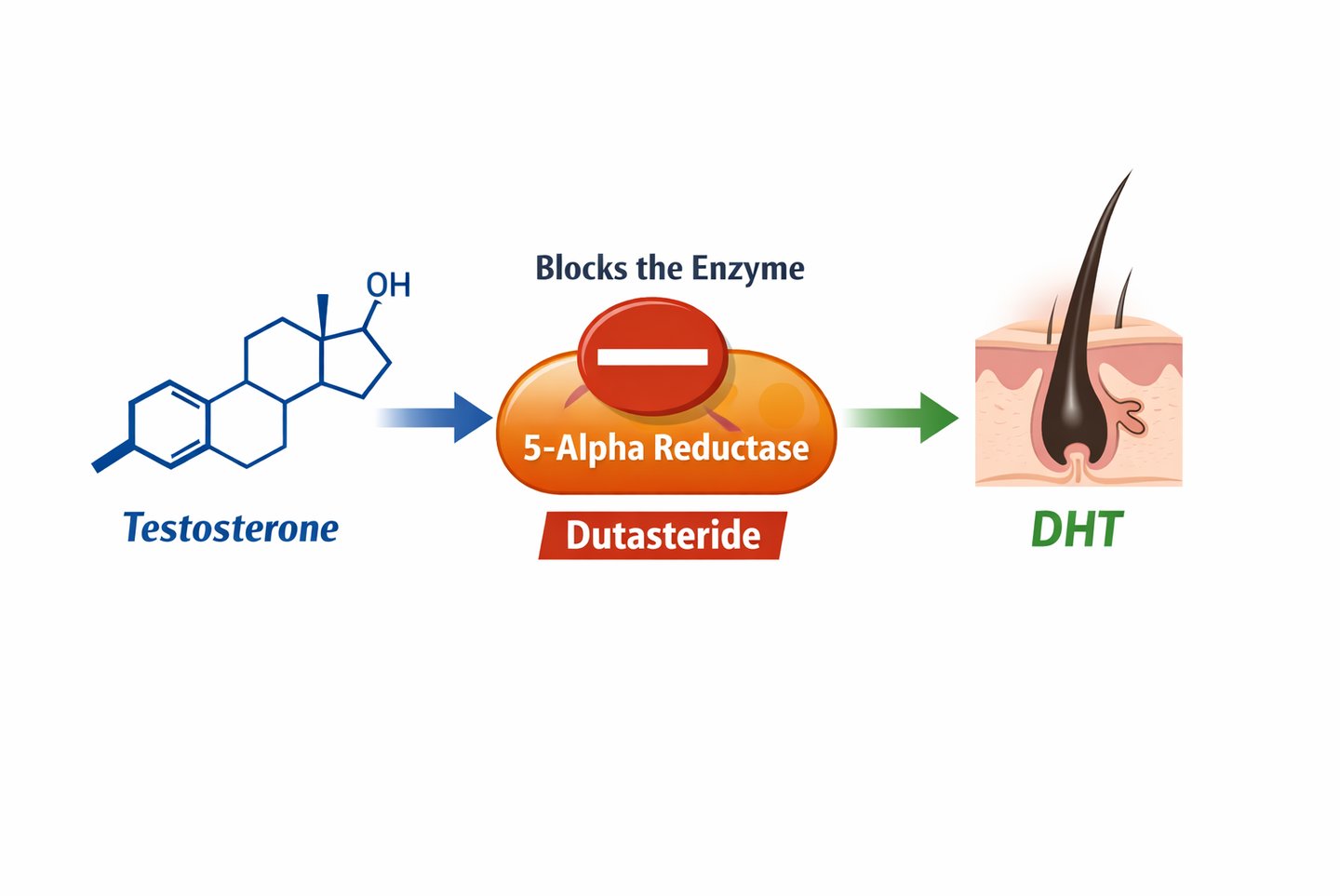
The drug name of a 5-alpha-reductase blocker, is Dutesteride.
Why I Choose Injectable Dutasteride Instead of Oral Dutasteride
Dutasteride is a medication used to treat pattern hair loss by reducing levels of dihydrotestosterone (DHT) — the hormone most responsible for hair follicle miniaturisation in genetically susceptible individuals. Specifically, it blocks the 5AR enzyme.
Dutasteride can be taken in tablet (oral) form or delivered as an injectable treatment directly into the scalp. While both approaches can be effective, my preference for many patients is to use injectable dutasteride, and this choice is based on how and where the medication acts in the body.
Why We Use a Loading-Dose Approach for Injectable Dutasteride
Dutasteride is a medication that works by blocking the conversion of testosterone into dihydrotestosterone (DHT), the hormone most strongly associated with pattern hair loss. When used as an injectable treatment into the scalp, the goal is to reduce local DHT levels around hair follicles while minimising whole-body exposure.
One important factor in determining how often treatments are given is how long the medication remains active in the tissues. Dutasteride is known to have a long biological half-life, meaning it stays in the body — and likely in scalp tissues — for weeks after administration. However, just like many long-acting medications, a single dose does not immediately create a stable, steady level in the target tissue.
If injections are given only once every three months from the outset, there may be a period early in treatment where medication levels in the scalp gradually decline before the next session. While the drug may still be present, this could lead to fluctuating exposure rather than a consistent therapeutic effect during the critical early months of treatment.
For this reason, our practice uses a loading-dose approach.
What Does This Mean?
Instead of starting with injections every three months, we typically perform:
• Monthly treatments for the first three months, followed by
• Maintenance treatments every three months thereafter
This initial phase allows dutasteride to accumulate gradually within the scalp tissues, helping to establish a more consistent local effect before moving to a longer maintenance interval.
Why This Matters
Hair follicles respond slowly to treatment. Most therapies for hair loss — including oral medications — take several months to reach a steady effect. The loading phase is designed to:
• Reduce early fluctuations in medication levels
• Provide more consistent DHT suppression during the early treatment period
• Align treatment timing with the biology of hair growth cycles
Important to Know
There is currently no universal guideline defining the ideal injection schedule for dutasteride, and protocols vary between clinics. Our approach is based on known pharmacology, emerging clinical experience, and a cautious, structured method aimed at consistency rather than rapid escalation.
As with all medical treatments, individual response varies, and dosing schedules may be adjusted based on progress, tolerance, and overall treatment goals.
Targeting the Scalp, Not the Whole Body
The primary goal of hair-loss treatment is to reduce DHT around the hair follicles in the scalp, where it causes hair thinning and shedding. Injectable dutasteride is placed directly into the scalp tissue, allowing the medication to act locally at the site of hair loss.
Oral 5AR blockers come in two forms, dutasteride (Avodart) which blocks 5AR type i and ii and finesteride which blocks 5AR type i. Unlike the scalp injections, oral 5AR blockers are absorbed into the bloodstream and lowers DHT throughout the entire body. This systemic effect is not always necessary to treat scalp hair loss.
Minimising Systemic DHT Reduction
DHT plays roles in the body beyond the scalp, including sexual function and libido. There is evidence that systemic DHT suppression, as occurs with oral dutasteride, may be associated in some patients with side effects such as:
• Reduced sexual drive
• Changes in sexual function
• Mood changes
Not everyone experiences these effects, but they are more likely when DHT is suppressed body-wide rather than locally.
By using an injectable, scalp-focused approach, the intention is to:
• Limit systemic absorption of the medication
• Reduce unnecessary whole-body DHT suppression
• Lower the likelihood of systemic side effects while still treating hair loss effectively
A More Targeted Medical Approach
In medicine, we generally aim to use the lowest effective exposure to achieve the desired result. Injectable dutasteride reflects this principle by focusing treatment where it is needed most — the scalp — rather than exposing the entire body to long-term hormonal changes.
Individualised Care
Injectable dutasteride is a prescription treatment and is not suitable for everyone. All patients undergo a medical consultation to discuss benefits, risks, alternatives, and whether this approach is appropriate for their individual situation.