
Hair loss and Alopecia treatment
What are some of the things that can be done to prevent hair loss:
Dutasteride prescription injections
plus many more

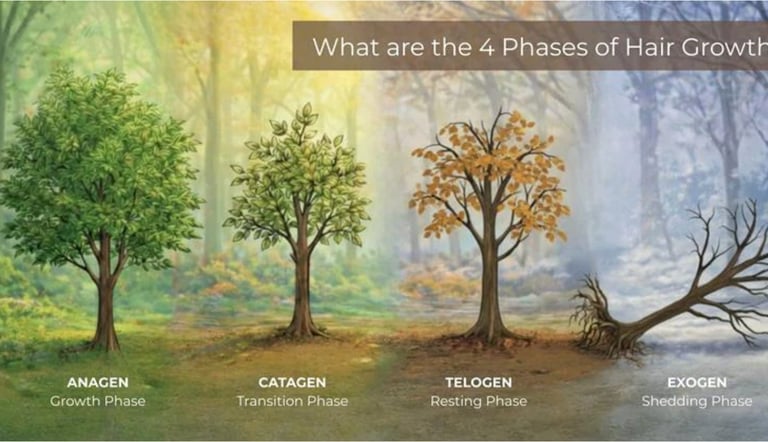
What are the phases of the hair life cycle?
Firstly, let us consider what is actually going on with hair growth. The hair cycle is a recurring process of hair growth, regression, rest, and shedding. It's essential for hair to continually renew itself throughout a person's life.
Anagen: The growth phase, when a new hair shaft is produced. This phase can last for a few months for eyelashes and eyebrows, or 2–6 years for scalp hair. At any one time, around 80-90% of the hairs on the scalp are in Anagen phase.
Catagen: A short transitional phase between anagen and telogen, when the follicle regresses slightly, and the hair itself separates slightly from the bottom of the follicle. This lasts about 2 weeks. Around 1-2% of scalp hair is in this phase at any one time.
Telogen: The resting phase, when the fully formed hair remains in the follicle. This phase lasts about 2-3 months and about 10% of scalp hair sits in this phase. At the same time, a new hair is beginning to grow up into the follicle ready to replace the old hair which will then fall out.
Exogen: The shedding phase, when hair is shed and replaced by a new hair shaft. It is normal to lose around 50-100 hairs per day from the scalp during this time. This is aided by brushing or washing your hair. This phase can last several months.
Factors that affect the hair life cycle
Stress - Physical and mental stress can cause hair to spend more time in the resting phase, which can slow down new hair growth.
Nutrition - A lack of protein, vitamin D, vitamin C, iron, zinc, folic acid, and vitamin B12 can contribute to unhealthy hair.
Hormones - Androgens like testosterone and dihydrotestosterone (DHT) control hair growth. Some hair cells in the body are particularly prone to DHT levels, namely the scalp. The body contains an enzyme (5-alpha-reductase or 5AR) the converts testosterone to DHT. DHT is 20 times more potent an androgen than testosterone. The more testosterone, including exogenous such as steroid use, the more DHT, and thus the more rapid hairless becomes. We can recommend products which can locally reduce the rate of DHT via 5AR, so that systemic DHT remains high, while protecting the scalp.
Stage 1: No significant hair loss or recession of the hairline.
Stage 2: Slight recession of the hairline, typically at the temples (“mature hairline”).
Stage 3: First stage of clinically significant hair loss, with deep recession at the temples forming an M, U, or V shape.
Stage 3 Vertex: Hairline recession similar to Stage 3, but with additional thinning at the crown (vertex).
Stage 4: More severe temple recession and noticeable bald spot on the crown, but still separated by a band of hair.
Stage 5: Hair loss at the temples and crown expands, with the bridge of hair between them thinning.
Stage 6: The bridge disappears, leaving only the sides and back with hair.
Stage 7: Most severe stage, with only a thin horseshoe-shaped band of hair remaining on the sides and back.
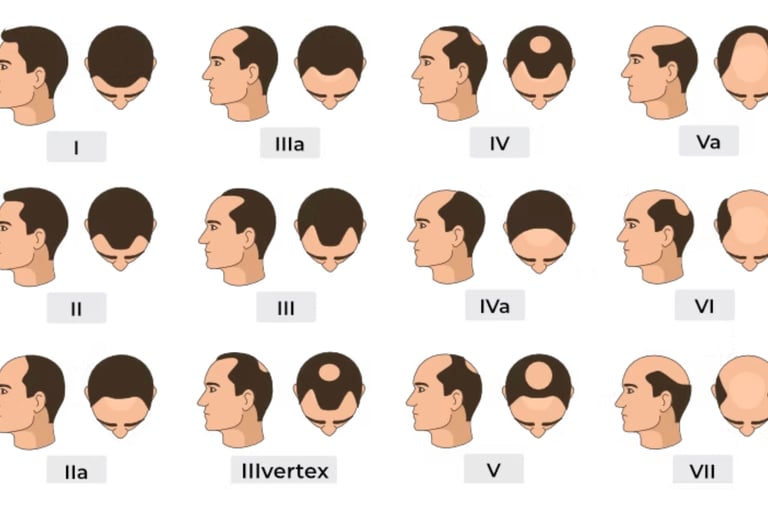
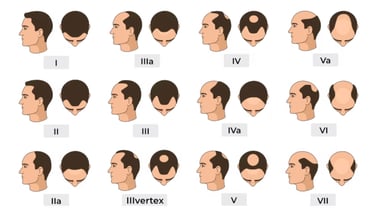
What level of hair loss do you have?
The Hamilton-Norwood Scale is a classification system used to measure the severity of male pattern baldness (androgenetic alopecia). It consists of seven stages, showing progressive hair loss: