
Minoxidil
Dosage
Topical Minoxidil is applied sparingly morning and night. It dries readily and does not leave a greasy appearance. They usually come as a foam and can be bought from local chemists for around $40 per bottle, which lasts for around 3 months.
Oral Minoxidil when used as a anti-hypertensive, has a starting dose at 10mg daily, and can be titrated up to 50mg daily. For use as a hairless treatment, dosage generally starts much lower, at 0.5mg per day and titrating up to a maximum of 5mg per day.
The initial outcomes of minoxidil become apparent after approximately 3 months of initiating the treatment, with the maximum effects manifesting around 4 months. Minoxidil affects the potassium channels present in vascular smooth muscles and hair follicles. This potassium channel activity may induce the following effects:
- Stimulation of the microcirculation around the hair follicles induces arteriolar vasodilation, thereby encouraging conditions conducive to hair growth.
- Induction of the vascular endothelial growth factor expression leads to heightened vascularization around the hair follicles, thereby promoting hair growth.
- Activation of the prostaglandin-endoperoxide synthase-1 enzyme leads to the enhancement of hair growth.
- Inhibition of androgen-related effects on androgen-sensitive hair follicles.
- Direct stimulation of the hair follicles as the drug acts as an epidermal growth factor on the matrix cells, slowing their aging process and extending their anagen phase. This process is achieved through the activation of the beta-catenin pathway.
- Display of antifibrotic characteristics due to its impact on collagen synthesis.
This medication should be used within 5 years of the onset of hair loss, before the miniturisation of the follicle becomes significant.
Adverse Effects:
Although minoxidil is generally well tolerated, possible adverse effects are as follows:
TOPICAL minoxidil:
- Minoxidil-induced telogen effluvium: The shortening of the telogen phase caused by minoxidil can result in excessive hair shedding in individuals.
- Skin irritation: This condition can lead to erythema, discomfort, and a burning sensation on the scalp.
- Scaly changes of the scalp: This condition can entail irritation or a potential worsening of seborrheic dermatitis.
- Isolated pruritus: appears in the area of application.
- Allergic contact dermatitis: This can lead to symptoms such as erythema, eczematous skin reactions, and pruritus. Minoxidil and propylene glycol are the primary allergens implicated in cases of allergic contact dermatitis. Patch testing can aid in identifying the underlying causative agent. If allergic contact dermatitis arises due to propylene glycol, topical minoxidil as a foam formulation can be an alternative option, as it does not contain propylene glycol.
- Localized or generalized hypertrichosis: Both oral and topical minoxidil usage can lead to hypertrichosis. However, this effect is more frequently observed with the oral formulation and when the 5% topical minoxidil solution is used compared to the 2% solution. Research indicates that hypertrichosis is linked to minoxidil extending the anagen phase. In addition, cases of hypertrichosis have been documented in infants due to unintentional direct skin contact.
ORAL minoxidil is also (in addition to the above list for topical) associated with significant adverse effects, as listed below:
- Rare but severe reactions include pericarditis, pericardial effusion, cardiac tamponade, exacerbating congestive heart failure, and worsening angina.
- Oral minoxidil administration can lead to significant hypotension and potential complications such as thrombocytopenia and leukopenia in individuals taking the medication.
- Breast tenderness and gynecomastia have also been reported as adverse effects of the medication.
- Hypertrichosis, edema, tachycardia, and weight gain are also caused by oral minoxidil.
A Brief History of Minoxidil and Its Use in Hair Loss
Minoxidil was originally developed in the late 1960s and early 1970s as an oral medication for severe, treatment-resistant hypertension. It was investigated because of its potent vasodilatory effects, acting directly on vascular smooth muscle to lower blood pressure. During early clinical trials, physicians began to notice an unexpected and consistent side effect: excessive hair growth (hypertrichosis) in patients taking the drug.
This observation prompted further investigation into minoxidil’s effects on hair follicles. Researchers found that the drug appeared to prolong the anagen (growth) phase of the hair cycle and increase follicular size, leading to thicker and longer hairs. These effects were not limited to the scalp, which initially limited its usefulness in oral form for cosmetic purposes.
To harness the hair-growth benefits while minimising systemic effects, minoxidil was reformulated as a topical solution in the late 1970s and early 1980s. Clinical trials demonstrated that topical application could stimulate scalp hair growth in individuals with androgenetic alopecia, leading to regulatory approval as the first non-prescription treatment for pattern hair loss.
Over time, further research clarified that minoxidil does not act hormonally but instead influences follicular cycling and local scalp biology. Today, minoxidil remains a cornerstone of hair-loss therapy, used in both topical and low-dose oral forms, with decades of clinical experience supporting its role in hair preservation and regrowth.
Why Topical Minoxidil Works for Some People but Not Others
Minoxidil can be used either topically (applied to the scalp) or orally (taken as a tablet). While both forms rely on the same active drug, they behave very differently in the body, and this explains why topical minoxidil does not work equally well for everyone.
Topical minoxidil is actually a pro-drug, meaning it must be converted into its active form (minoxidil sulfate) before it can stimulate hair growth. This conversion is carried out by an enzyme called sulfotransferase, which is present in the scalp hair follicles. Research has shown that not everyone has sufficient sulfotransferase activity in their scalp, and people with low activity may see little or no response to topical minoxidil, even when used correctly. Due to the lack of research, the incidence of the genetics in this regards are unknown.
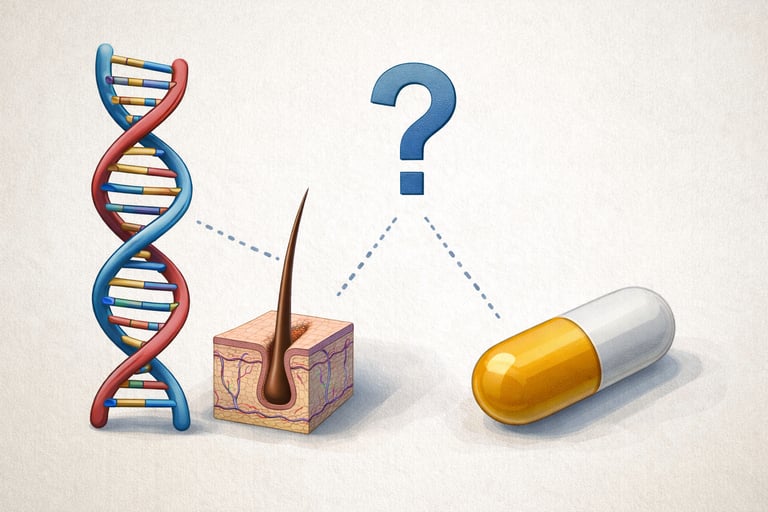
Oral minoxidil works differently. When taken by mouth, it is converted into its active form in the liver, where sulfotransferase activity is consistently present in all individuals. This means that everyone has the biological capacity to activate oral minoxidil, making the response more predictable.
In simple terms:
• Topical minoxidil depends on a scalp-specific enzyme that some people lack
• Oral minoxidil relies on liver metabolism, which is universal
This genetic and enzymatic difference helps explain why some patients see excellent results with topical minoxidil, while others respond better to the oral form. Treatment choice should always be individualised and discussed with a medical professional.